| |
-
|
Abstract
The greatest scientific discovery of the 20th Century is considered to be the multiple-inventor, independent discovery of high-density electron charge clusters (HDCC) and their uses.
The HDCC technology has been independently discovered and advanced by Shoulders and Gleeson in the U.S., Alexander Ilyanok in Belarus, and Mesyats and Baraboshkin in Ekaterinburg, Russia.
Charge clusters are developed in low pressure gases, in the atmosphere, and in liquids under special conditions. Other new-energy devices have also been patented and are being developed.— Hal Fox
|
Many scientific investigators are so involved in proving their own theories that they ignore evidence of new discoveries.
An example can be found in the search for materials that exhibited luminescence as a function of voltage. The search was to find a better method for displaying computer output, and was terminated by the discovery of light-emitting diodes.
The early work involved the use of some of the "valve metals," a term applied to those metals which emitted electrons when heated. Valve metals were used as filaments in the early days of electronic vacuum tubes. The British used the term "valve." In America, we called them radio tubes.
In several of the investigations of valve metals it was found that the luminescence increased with voltage up to the stage where the electrodes began "sparking." It was immediately recognized that a sparking electrode would not produce the luminescence desired, yet there was no interest in determining why such sparking occurred.
In one case, it was found that the electro-chemical liquid being used had an element which was not present in the original liquid. But because scientists were (and still are) taught that nuclear reactions can only occur with high energies, this measurement was classed as "obvious contamination."[1]
Had one of these several researchers pondered why a metal should produce a visible spark on its surface, then the current history of the discovery of high-density electron charge clusters (HDCC) would have been different.
The message to all those who do significant research is not to ignore the evidence — especially the unexpected results. It is proper to have a hypothesis for guiding an experiment, but it makes no sense for the researcher to simply ignore data that fails to correspond to that hypothesis.
Early Discovery Work
One of the finest laboratory experimenters is Kenneth R. Shoulders. It is a delight to listen to him discussing his experimental work. You soon find that he is not so encompassed by current scientific dogma that he must classify all observations by current belief structures. He is patient, inventive, and essentially immune to the concept that current science has all the answers.
Kenneth Shoulders was the first to discover and obtain a patent using HDCC technology.[2]
When warned by his patent attorney that there was a strong likelihood that his patent application would be classified as secret by the government officials that review new discoveries, Shoulders responded by writing a book detailing much of the experimental work that he had accomplished.[3]
Then, immediately after he had filed the patent application, he mailed copies of the book to a list of several scientists in various countries. As expected, the invention was classified, but when the officials of the patent office asked to know who had received his book, it was most unfortunate that the computer had eaten the address list. Within a few days, the patent officials decided to give up on the classification.
Kenneth Shoulders, working with low pressure gases, had found that under certain conditions (including short pulses of input electrical energy) HDCC could be formed, directed, and controlled. The discoveries involved many manifestations of HDCC, including the structure, size, the necklace-like 20-micron diameter, and the peculiar quantization such that additional energy creates HDCC structures that are 50-microns in diameter.[4]
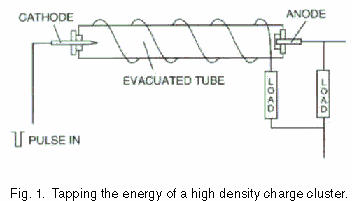 Note that Shoulders uses the term EV for these fascinating charge clusters. Because of the frequent use of EV for Electric Vehicles, the authors use the term HDCC. Figure 1 shows the device description essentially as it appears on the first page of U.S. Patent No. 5,018,180. Note that Shoulders uses the term EV for these fascinating charge clusters. Because of the frequent use of EV for Electric Vehicles, the authors use the term HDCC. Figure 1 shows the device description essentially as it appears on the first page of U.S. Patent No. 5,018,180.
HDCC in Liquids
The late Stan Gleeson, of Cincinnati, Ohio, discovered some peculiar effects in water solutions when subjected to electrical voltages under proper conditions.[4]
After the author was contacted by Stan Gleeson, Dr. Shang Xian Jin (working with Trenergy, Inc., and with some modest help from Fox) spent many months in experimenting with and solving some of the problems working with low-level radioactive liquids.
Trenergy obtained a gamma-ray detector, and Jin made measurements of before-and-after processing to determine the amount of radioactivity reduction achieved by about 30 minutes of processing time.
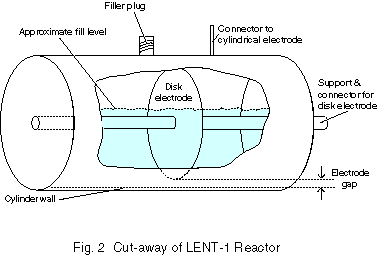 There can be significant reduction of the amount of radioactivity in the thorium solution.[5] There is still some question as to the precise amount of radioactivity that is contained in the precipitates from this type of processing. Figure 2 is an outline drawing of the type of sealed transmutation cell used for transmuting radioactive liquids. There can be significant reduction of the amount of radioactivity in the thorium solution.[5] There is still some question as to the precise amount of radioactivity that is contained in the precipitates from this type of processing. Figure 2 is an outline drawing of the type of sealed transmutation cell used for transmuting radioactive liquids.
In addition to the study of radioactive liquids, Dr. Jin made some attempts to mathematically describe the HDCC. With a suggestion by the author that the form of the individual HDCC would have to be a toroid, Jin was able to show that electrons circulating around a toroid could produce a sufficiently large magnetic field within the toroid to stabilize the electron flow.[6] Obviously, it is important to explain why a cluster of about 100 million electrons does not just fly apart by mutual repulsion.
This paper also presents some initial mathematical conditions for stability of HDCC as a function of size. It is considered that ball lightning is probably a very large HDCC. The problem of mathematically showing why HDCC are quantized (1/2 to 3 microns for individual HDCC; 20 and 50 microns for HDCC necklaces) has not, as yet, been solved.
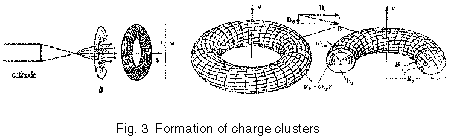 It might be added that the HDCC phenomenon is far more complicated than would be indicated by the early attempts to describe it. Figure 3 shows our conception of how high-density, charge clusters are formed and travel as one micron toroids. It might be added that the HDCC phenomenon is far more complicated than would be indicated by the early attempts to describe it. Figure 3 shows our conception of how high-density, charge clusters are formed and travel as one micron toroids.
Additional Discoveries
Dr. Alexander Ilyanok described similar discoveries which he made independently of any previous discoveries.[7] Ilyanok found the same 20-micron and 50-micron structures of the HDCC.
He also worked for some time to try to determine what the next quantization (after the 50 micron size) of the HDCC would be. The rumor is that the next step is 140 microns, but the author has found no papers reporting this discovery. It is still a mystery why HDCC should be quantized. What strange complexity of nature provides for cluster stability only in these sizes?
The next independent discovery of HDCC was obtained by Mesyats, working in conjunction with Baraboshkin. Mesyats was sure that he had been the first to find this interesting phenomenon and named the clusters "Ectons."
Mesyats wrote and presented a paper in California at XVIIth International Symposium on Discharges and Electrical Insulation in Vacuum.[8] (Shoulders calls this the "arcs and sparks conference." It was with some disappointment to Mesyats that Shoulders (who was present at Mesyats's presentation) gently informed him that his Ectons were Shoulders's EVs, and that patents had already been issued in the United States.
A recent (October, 2001) bit of information concerning HDCC has been revealed by another Russian scientist, Oleg V. Gritskevitch.[9] Gritskevitch makes the following statement about his Hydro-Magnetic Dynamo:
It is also known that the dynamo uses high-density charge clusters. High-density charge clusters are thought by some theorists to be the basis of plasma-injected transmutation of elements and also neutralization of radioactive materials. Unlike hot fusion and fission reactors, the dynamo does not accumulate any radioactive components.
Current Work
It is currently understood and published that the HDCC technology (considering experiments in both liquids and low pressure):
- Can produce both thermal and electrical energy in excess of input energy.
- Can be used to reduce radioactivity in radioactive liquids.
- Can create nuclear reactions.
- Is involved in other new-energy discoveries.
- Obtains its excess energy from tapping the "zero-point radiation of the vacuum continuum."
It is suggested but not proven that HDCC production (either known or unknown) is responsible for some of the following effects:
- The processing of aluminum sheet to greatly increase surface area for use in electric capacitors.
- The Papp engine.[10] In fact, it is suggested that Papp's life was shortened by the peculiar effects of possible neutron emission that HDCC produced in his engine.
- The over-unity effects of the Correa and Correa patented invention.[11]
- The unexpected additional energy found by Graneau when using plasma discharges to accelerate water jets (or water fog).[12]
- Many new effects discovered as low-energy nuclear reaction experimenters produced underwater arcing as voltage was increased in electrochemical cells.[13] and [14] (note that in addition to these two references, many others could be cited).
- The discoveries of Santilli, where new-energy gases (MagneGas) are obtained from underwater arcing in specific types of solutions.[15]
It is possible that many of the proven over-unity devices and systems depend on the unknown (or known) generation of HDCC.
For example, one possible source of the excess energy and/or new elements found in deuterium/palladium electrochemical cells could be the production of HDCC formed when the palladium lattice cracks.
It is known that the palladium cathode becomes stressed (from being loaded with deuterium) and brittle (the well-known hydrogen embrittlement). Kenneth Shoulders suggests that the crack severs trillions of ionic bonds which provides a high voltage that quickly shorts out through the conductive palladium.
This short-duration, high-voltage spike produces a charge cluster from the cathode side and is accelerated to the anode side, but it also picks up deuterons. The end result can be sufficient velocity to cause nuclear reactions when the combined charge cluster strikes the palladium anode side of the crack.
Other New-Energy Discoveries
Many of the new-energy devices have an electrical input and provide thermal output. Because the current cost of thermal energy (from the burning of natural gas) is about three times the cost of electrical energy, it has been this author's policy to ignore new-energy developments that do not provide at least three times as much energy output as input energy.
The Mills Device
Dr. Randell Mills has discovered, patented, and developed a new-energy device that obtains its excess energy from (according to Mills) the collapse of the hydrogen atom below its normal ground state.
The end result is a device that can produce considerably more thermal energy output than the input energy consumed.[16]
Currently it is reported that BlackLight Power is developing an improved small generator that uses the high-temperature gases from the Mills' device to power the motor.
The Russian Thermal Device
A Russian scientist, working in a nuclear-engineering plant, has discovered a method by which considerable thermal energy can be developed. This device uses an ultrasonic crystal vibrator to surge a mixture of light and heavy water through a special material. The water surging back and forth through one millimeter holes produces a very high voltage in this special (and secret) material.
The end result is that the device is reported to produce twenty times the thermal energy output compared to electrical energy input. Also reported is that there are very few emanations from this device that can harm a person. Therefore, it is anticipated that this device can be developed for furnishing thermal energy for use in greenhouses, homes, and offices.
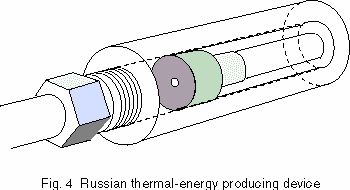 Figure 4 is an outline drawing of the Russian thermal energy device. At the left end is an electrically-energized, piezo-electric transducer. In the middle of the cell is an undisclosed material that produces high voltage and the excess thermal energy when the mixture of light and heavy water surges through a hole or holes in this solid material. Figure 4 is an outline drawing of the Russian thermal energy device. At the left end is an electrically-energized, piezo-electric transducer. In the middle of the cell is an undisclosed material that produces high voltage and the excess thermal energy when the mixture of light and heavy water surges through a hole or holes in this solid material.
Future Work Projections
As stated above, it is the author's opinion that the multiple, independent discovery of high-density electron charge clusters (HDCC) and their uses constitutes the greatest scientific discovery of the 20th Century. It is suggested that the greatest new-energy source of the 21st Century will arise from further development and commercialization of this technology.
The ability to obtain energy from tapping the "zero-point radiation of the vacuum continuum" means that this important discovery will become a major source of non-polluting, inexpensive energy.
 Here are some of projected developments that will be made within the next one or more years: Here are some of projected developments that will be made within the next one or more years:
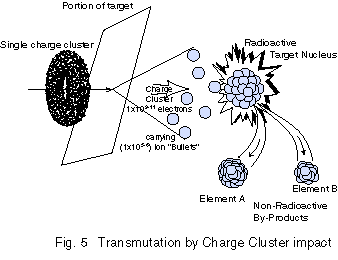
- The use of high-density charge clusters (HDCC) to stabilize radioactive wastes. (Figure 5 depicts the impact of a combined HDCC onto a radioactive solid and the resultant fissioning of the elements impacted.)
- The commercialization of HDCC devices for the production of thermal and/or electrical energy.
- The development of electrical systems to be installed in electric vehicles to charge or replace batteries (creating the long-sought, zero-pollution vehicle).
- The economic commercialization of methods of producing scarce elements from more plentiful elements.
- The production of agricultural grade water from sea water or other brackish waters.
In general, using HDCC and other new-energy devices, there will be a dramatic change in the way the world produces and distributes energy.
Considering that the size of the fossil-fuel market amounts to $4.5 trillion per year, it is expected that over the next decade one of the world's most vigorous and important new-energy industries will spread throughout the world.
Investors and corporations that become involved in this technology are expected to prosper. However, it will take an estimated decade, and billions of billions of dollars in investments, to penetrate just ten percent of the current energy market.[17]
Acknowledgements
The authors are strongly indebted to EEMF, Inc. (which has exclusive rights to all HDCC patents that have issued) for financial support. In addition, the authors are indebted to those scientists and their funders who have the ability to recognize and develop new science. Among these are Kenneth Shoulders, the late Stan Gleeson, Alexander Ilyanok, Vasily Baraboshkin, G. A. Mesyats — and those who funded their work.

Top of Page
 Print Version
|
|
|

 High-Density